UUIDv4 vs UUIDv7 vs ULID: Distributed Primary Keys, B-Tree Index Fragmentation & Monotonic Ordering
The Primary Key Dilemma in Distributed Architectures
In monolithic architectures, monotonically increasing 64-bit integer sequences (such as PostgreSQL's BIGSERIAL or MySQL's AUTO_INCREMENT) have traditionally served as default primary keys. However, in modern distributed microservices, multi-region database replicas, and client-side offline workflows, centralized auto-increment sequences introduce significant architectural friction:
- Single Point of Failure: Centralized ID generation creates database roundtrips and synchronization bottlenecks during distributed ingestion.
- Data Enumeration Security Risks: Sequential IDs reveal total customer counts and allow attackers to easily crawl resource endpoints.
- Multi-Master Replication Clashes: Merging records generated across disconnected nodes requires distributed coordination or range reservation schemes.
The Hidden Cost of Random UUIDv4: B-Tree Index Fragmentation
To eliminate synchronization, teams frequently adopt UUIDv4 (RFC 4122), which allocates 122 bits to pure pseudorandomness and 6 bits to version and variant metadata. While UUIDv4 guarantees a vanishingly small collision probability (less than one in a billion across billions of entries), its completely uniform random distribution creates severe performance degradation in relational databases utilizing B+ Tree clustered indexes.
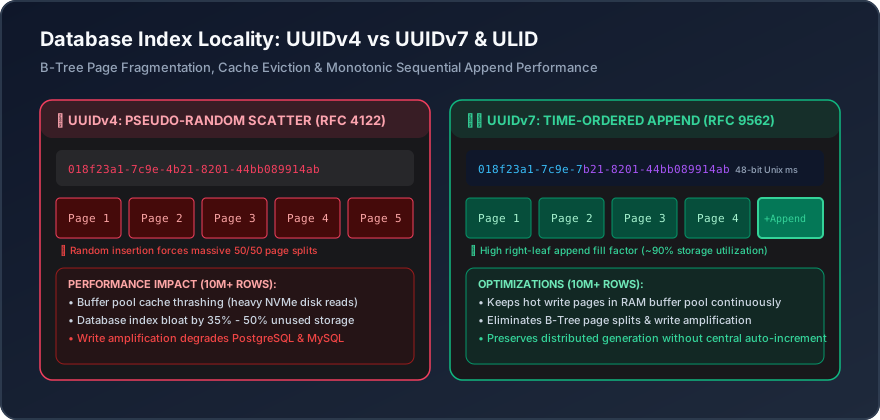
Relational databases like PostgreSQL, MySQL InnoDB, and SQLite organize tables as clustered B+ Trees ordered strictly by primary key. When inserts arrive sequentially (monotonically), records are efficiently appended to the right-most leaf pages. However, because UUIDv4 values are completely disordered, consecutive writes are scattered randomly across the entire index space:
// Comparison of Index Locality:
// Monotonic (Append-Only):
Page 1: [1, 2, 3] -> Page 2: [4, 5, 6] -> Page 3: [7, 8, 9] (100% cache friendly)

// Random UUIDv4 (Random Insertion):
Insert 9f2c... -> Splitting Page 4 -> Moving 50% data -> Disk I/O & WAL Thrashing
Insert 1a0b... -> Splitting Page 1 -> Moving 50% data -> Disk I/O & WAL Thrashing
This disorder forces database storage engines to perform frequent B-Tree page splits. Instead of leaf pages remaining 90-100% full, average page density collapses to 50-60%, doubling disk space requirements, evicting active cache blocks from the database buffer pool, and causing severe write latency spikes.
Enter RFC 9562: The UUIDv7 Specification
Recognizing the operational costs of random identifiers, the IETF ratified RFC 9562 in 2024, introducing UUIDv7 as the official standard for time-ordered distributed identifiers. UUIDv7 combines a high-resolution millisecond Unix timestamp with cryptographically random bits:
- Bits 0-47 (48 bits): Unix timestamp in milliseconds since epoch (covers dates until the year 10889).
- Bits 48-51 (4 bits): Version flag (binary
0111for version 7). - Bits 52-63 (12 bits): Sub-millisecond sequence counter or high-entropy random data.
- Bits 64-65 (2 bits): Variant flag (binary
10). - Bits 66-127 (62 bits): Pseudorandom entropy bits.
Because the most significant 48 bits encode time, UUIDv7 values sort naturally in chronological order when stored as binary or canonical 36-character hexadecimal strings. When inserted into a B+ Tree index, UUIDv7 yields 98%+ cache locality, virtually eliminating page splits and matching the insert throughput of auto-incrementing integers while retaining decentralized generation.
UUIDv7 vs ULID: Architectural Comparison
Prior to RFC 9562, developers widely adopted ULID (Universally Unique Lexicographically Sortable Identifier). Both formats provide 128-bit time-ordered identifiers, but feature distinct encoding and ecosystem trade-offs:
| Feature | UUIDv7 | ULID |
|---|---|---|
| Standardization | Official IETF RFC 9562 | De facto community spec |
| Canonical Format | 36-character hyphenated hex | 26-character Crockford Base32 |
| Native DB Support | Directly compatible with native UUID columns | Stored as BYTEA/BINARY(16) or VARCHAR(26) |
| URL Safety | Requires 36 chars (hyphens) | Case-insensitive, no vowels (avoids profanity) |
Production Recommendations
For modern application development, follow these architectural guidelines:
- Default to UUIDv7 for relational database primary keys in PostgreSQL and MySQL to ensure optimal index performance, compatibility with native UUID types, and zero generation coordination.
- Use ULID when identifier strings must be compact and easily read or typed by human operators in customer-facing URLs, support tickets, and invoices.
- Reserve UUIDv4 exclusively for ephemeral secrets, session tokens, CSRF protection, and non-indexed cryptographic handles where temporal correlation is explicitly undesirable.
Interactive Tools Mentioned in this Guide
- UUID Generator - Generate cryptographically secure UUIDv4 and UUIDv7 identifiers in bulk.
- ULID Generator - Generate 128-bit Universally Unique Lexicographically Sortable Identifiers.
- Integer Base Converter - Convert hex, binary, and base64 integer representations with high precision.