Production HTTP Architecture: Status Codes Semantics, Idempotency, Caching Headers & Security Flags
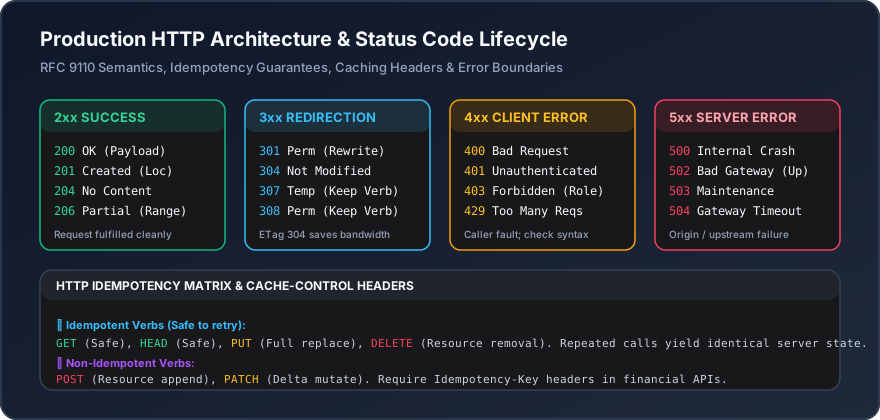
The Semantics of HTTP in Modern Microservices
Hypertext Transfer Protocol (RFC 9110) governs communication across the distributed web. While web frameworks simplify request and response handling, designing resilient, performant, and secure RESTful APIs requires deep adherence to HTTP status semantics, caching negotiation, and idempotency guarantees.
Disambiguating Confusing HTTP Status Codes
Production APIs frequently misuse response status codes, confusing client libraries, SDKs, and automated retry mechanisms:
- 401 Unauthorized vs 403 Forbidden:
401 Unauthorizedsignifies unauthenticated requests (missing or invalid Authorization bearer token). The client should prompt for credentials or refresh the token.403 Forbiddensignifies that the user is authenticated, but their roles or permissions do not permit access to this specific resource. Retrying with identical credentials will not succeed.
- 200 OK vs 204 No Content vs 202 Accepted:
200 OK: Synchronous operation completed; returns a serialized payload body.204 No Content: Synchronous operation completed successfully (e.g.DELETE), but there is deliberately no body to return. Clients must not attempt to parse JSON.202 Accepted: The request has been accepted for background processing (e.g. asynchronous queue), but processing is not yet complete. Typically returns aLocationheader to poll progress.
- 409 Conflict vs 422 Unprocessable Entity:
409 Conflict: The request cannot be completed due to a conflict with current server state (e.g. optimistic concurrency lock violation or duplicate unique constraint).422 Unprocessable Content: The request body is well-formed JSON syntax, but contains semantic validation errors (e.g. invalid email format or negative price).
HTTP Method Idempotency and Safe Retries
In network computing, an HTTP method is idempotent if executing multiple identical requests produces the exact same side-effect on the server as executing a single request:
| Method | Safe (Read-Only) | Idempotent | Semantics |
|---|---|---|---|
| GET | Yes | Yes | Retrieve resource representation without side effects |
| PUT | No | Yes | Completely replace resource at target URI |
| DELETE | No | Yes | Delete target resource; subsequent calls return 404/204 |
| POST | No | No | Create subordinate resource or execute generic commands |
| PATCH | No | No (often) | Apply partial delta modifications to target resource |
Because POST is non-idempotent, network drops during payment or transaction processing can cause double charges if clients blindly retry. To make non-idempotent operations safe, production APIs implement an Idempotency-Key header:
// Client generates UUIDv7 for the transaction:
POST /v1/charges
Idempotency-Key: 0192534a-1a80-7b2c-9a00-4b216fe0d12e
Content-Type: application/json

// Server stores key in Redis for 24 hours:
// If key exists in cache -> return stored response immediately without re-executing charge
HTTP Caching: Max-Age, Stale-While-Revalidate & ETags
Optimizing web application speed requires intelligent cache invalidation:
Cache-Control: public, max-age=3600, s-maxage=86400, stale-while-revalidate=300: Instructs browser to cache for 1 hour, CDN edges to cache for 24 hours, and allows serving stale content for 5 minutes while the CDN updates asynchronously in the background.- ETag (Entity Tag) & If-None-Match: The server computes a cryptographic hash of the resource representation (
ETag: "33a64df551425fcc"). Subsequent client requests includeIf-None-Match: "33a64df551425fcc". If the resource has not changed, the server immediately returns304 Not Modifiedwith zero response body, saving 99% of bandwidth.
Critical Security Headers Checklist
Every production web application should enforce these security headers on all responses:
Strict-Transport-Security: max-age=63072000; includeSubDomains; preload: Enforces HTTPS strictly and prevents SSL-stripping attacks.Content-Security-Policy (CSP): Restricts authorized origins for scripts, styles, fonts, and worker contexts to neutralize Cross-Site Scripting (XSS).X-Content-Type-Options: nosniff: Prevents browsers from MIME-sniffing away from the declared content type.X-Frame-Options: DENY: Disallows embedding inside iframes to prevent clickjacking.Referrer-Policy: strict-origin-when-cross-origin: Protects sensitive URL query parameters from leaking to external referrers.
Interactive Tools Mentioned in this Guide
- HTTP Status Codes - Interactive directory of all standard IETF HTTP response status codes with specifications.
- API Request Tester - Test REST and GraphQL endpoints in-browser with headers, body payloads, and status analysis.
- cURL to Code Converter - Convert curl commands to production Python, Node.js, and Go HTTP client code.