Bcrypt vs Argon2 vs PBKDF2: Choosing the Right Hashing Algorithm in Modern Security
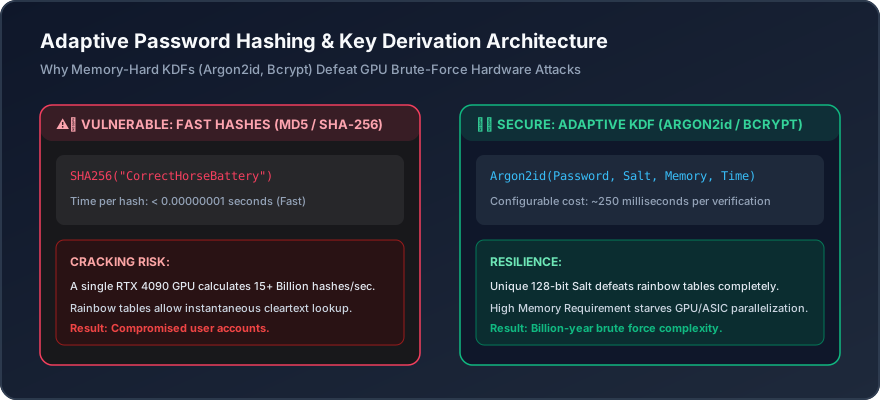
The Fatal Flaw of Fast Hash Functions for Passwords
A common beginner mistake in web development is storing user passwords using general-purpose cryptographic hash functions such as MD5, SHA-1, or even SHA-256. While these functions are essential for file integrity verification, digital signatures, and hash tables, they are disastrous for password storage.
Modern consumer GPUs (like an NVIDIA RTX 4090) can compute tens of billions of SHA-256 calculations per second. If an attacker dumps a database containing SHA-256 password hashes, they can brute-force an 8-character password in minutes or query rainbow tables for instantaneous matches. Password storage requires an intentionally slow, adaptive key derivation function.
Understanding Salt and Work Factor
Secure password hashing relies on two fundamental pillars:
- Cryptographic Salt: A unique, random string generated for every single password before hashing. Salts prevent attackers from precomputing rainbow tables and ensure that two users with identical passwords will never have the same hash.
- Work Factor (Cost): A configurable parameter that dictates how computationally intensive the hash calculation is. As hardware becomes faster over time, administrators can increase the work factor without changing the hashing algorithm.
Deep Dive: The Major Modern Algorithms
1. Bcrypt (Blowfish-Based)
Created by Niels Provos and David Mazières in 1999, Bcrypt uses an adapted version of the Blowfish block cipher called Eksblowfish (Expensive Key Schedule Blowfish). Bcrypt incorporates a 128-bit salt and an exponential cost factor (typically 10 to 14 rounds in production).
Bcrypt has resisted cryptanalysis for over two decades and remains widely supported in standard libraries (Java, Python, Node.js, Go). Its only major technical limitation is a maximum password input length of 72 bytes, which applications handle by pre-hashing longer inputs with SHA-256 when necessary.
2. Argon2 (Winner of the Password Hashing Competition)
In 2015, the open Password Hashing Competition selected Argon2 as the premier state-of-the-art password hashing standard. Argon2 comes in three variants:
- Argon2d: Optimized against GPU cracking attacks; maximizes memory access speed but is vulnerable to side-channel cache attacks.
- Argon2i: Optimized against side-channel timing attacks using data-independent memory access.
- Argon2id (Recommended): A hybrid variant that combines the strengths of Argon2d and Argon2i, providing defense against both side-channel attacks and GPU/ASIC acceleration.
Argon2 allows configuration across three dimensions: execution time (iterations), memory usage (kilobytes), and parallelism (threads), making it the most future-proof algorithm available today.
3. PBKDF2 (Password-Based Key Derivation Function 2)
Defined in RFC 2898 and approved by NIST, PBKDF2 applies a pseudo-random function (such as HMAC-SHA256) repeatedly in a loop. Because it is recognized under FIPS standards, PBKDF2 is heavily used in enterprise, government, and banking environments. However, because PBKDF2 relies on negligible memory, attackers can build custom ASIC chips that calculate PBKDF2 rounds far cheaper than Argon2 or Scrypt.
Practical Implementation Guidance
| Algorithm | NIST Status | Memory Hardness | Recommended Usage |
|---|---|---|---|
| Argon2id | Recommended | High (Configurable) | New projects, greenfield architectures |
| Bcrypt | Legacy Accepted | Medium (4 KB) | Existing systems, universal library compatibility |
| PBKDF2 | FIPS Compliant | Very Low | Strict enterprise/government compliance requirements |
Summary
Never implement roll-your-own hashing. Use battle-tested libraries and choose Argon2id for new systems or Bcrypt (cost 12) for universal compatibility. Always test password hashing performance locally to ensure each verification takes approximately 200–300 milliseconds on your target server.
Interactive Tools Mentioned in this Guide
- Bcrypt Hash & Compare - Generate salt rounds and verify bcrypt passwords
- Hash Text Generator - Compute MD5, SHA-1, SHA-256, and SHA-512 hashes
- Password Strength Analyser - Analyze password entropy, dictionary resilience, and crack time