Developer Productivity
10 min read
Updated 2026-10-12
Mastering Regular Expressions: Engine Mechanics, Catastrophic Backtracking & High-Performance Regex
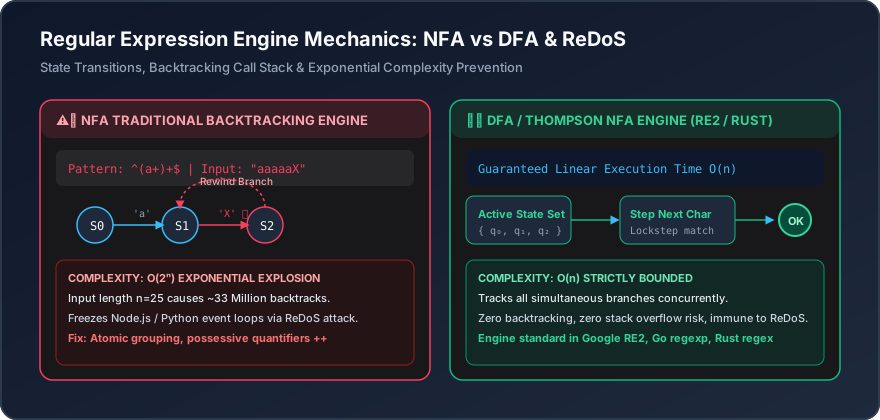
The Two Types of Regular Expression Engines
Regular expressions exist in almost every programming language, but how they execute under the hood depends on the regex engine architecture:
- Deterministic Finite Automata (DFA): Used by tools like GNU grep and Google's RE2 library. DFAs process text in linear time
O(n)regardless of expression complexity. However, DFAs cannot support backreferences or complex lookarounds. - Non-deterministic Finite Automata (NFA): Used by JavaScript (V8), Python, Java, PHP, and PCRE. NFAs support rich features like lazy quantifiers, lookaheads, and capture groups, but they rely on backtracking when candidate matches fail.
Zero-Width Assertions (Lookaround Mechanics)
Lookarounds match a position in a string without consuming characters or including them in the final match:
- Positive Lookahead
(?=...): Matches if the pattern inside matches immediately after the current position. (e.g.d+(?=px)matches100in100px). - Negative Lookahead
(?!...): Matches if the pattern inside does NOT match immediately after the current position. (e.g.d+(?!px)matches100in100em). - Positive Lookbehind
(?<=...): Matches if the pattern inside matches immediately preceding the current position. (e.g.(?<=$)d+matches50in$50). - Negative Lookbehind
(?<!...): Matches if the pattern inside does NOT match immediately preceding the current position.
Catastrophic Backtracking (ReDoS)
When an NFA regex combines nested or adjacent quantifiers with ambiguity, an engine can evaluate exponential paths when processing an input string that almost matches but ultimately fails at the end.
Dangerous Pattern: ^(a+)+$
Input Text:        aaaaaaaaaaaaaaaaaaaaaaaaaaaa!
For an input of only 30 characters, the engine may attempt 2^30 (over 1 billion) backtracking paths, locking the Node.js event loop or web worker CPU at 100% for minutes. This vulnerability is known as Regular Expression Denial of Service (ReDoS).
Rules to Prevent ReDoS
- Avoid nesting quantifiers like
(a*)*,(a+)+, or([a-zA-Z]+)*. - When matching delimited tokens, use negated character classes instead of lazy catch-alls (prefer
"[^"]*"over".*?"). - Set execution timeouts on user-supplied regular expressions in production backend services.
Interactive Tools Mentioned in this Guide
- Regex Cheatsheet - Comprehensive quick-reference table for regex syntax
- String Obfuscator - Encode, escape, and transform plain strings
- Text Diff Viewer - Compare differences between two code or text blocks