Data Serialization in Modern Systems: JSON vs YAML vs XML Benchmark, Syntax & Parser Security
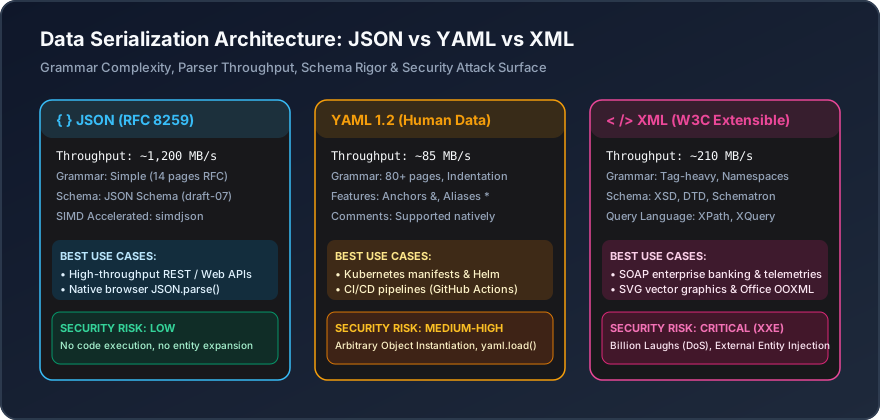
The Core Dilemma: Machine Efficiency vs Human Readability
Every software system must transfer data between disjoint components: microservices talking to frontend clients, containers reading runtime configuration, or databases serializing document state. Three formats dominate the modern software landscape: JSON, YAML, and XML.
1. JSON (JavaScript Object Notation)
Standardized in RFC 8259, JSON has become the undisputed lingua franca of the web. Its syntax maps directly to universal data structures found in virtually every programming language: key-value dictionaries (objects) and ordered lists (arrays).
Strengths
- Blazing Parse Speed: Modern browsers and runtimes include hardware-optimized C++ parsers (e.g.,
JSON.parse()in V8 can parse hundreds of megabytes per second). - Simplicity: Only six basic types: string, number, boolean, null, object, and array.
Weaknesses
- No native comments support in standard JSON (leading to formats like JSON5 or JSONC).
- No built-in support for binary buffers, dates, or circular references.
2. YAML (YAML Ain't Markup Language)
Designed primarily for human readability, YAML is the preferred configuration language for DevOps tools including Kubernetes, Docker Compose, GitHub Actions, and Ansible.
Strengths
- Minimalist syntax using indentation instead of braces and quotes.
- Native support for comments, multi-line strings, and document anchors/aliases (
&anchorand*alias).
Weaknesses & Security Risks
- Significant Whitespace Bugs: A single misaligned tab or space can alter the interpretation of an entire configuration tree.
- Billion Laughs / Entity Expansion: Recursive YAML anchors can trigger memory exhaustion Denial of Service (DoS) attacks.
- Arbitrary Code Execution: Many default YAML loaders (like Python's
yaml.load()prior to SafeLoader) allowed object deserialization that enabled remote code execution.
3. XML (Extensible Markup Language)
Introduced by the W3C in 1998, XML is a document-oriented markup format with strict schema definitions (XSD, DTD) and rich query languages (XPath, XQuery). While largely replaced in REST APIs by JSON, XML remains foundational in enterprise banking (ISO 20022), SOAP web services, SVG vector graphics, and Office Open XML documents.
Critical Vulnerability: XML External Entity (XXE)
If an XML parser is improperly configured, attackers can define external entities that read arbitrary files from the server filesystem or trigger internal Server-Side Request Forgery (SSRF):
<!DOCTYPE test [
  <!ENTITY xxe SYSTEM "file:///etc/passwd">
]>
<payload>&xxe;</payload>
Always disable external DTDs and entity resolution in production XML parsers.
Format Comparison Matrix
| Feature | JSON | YAML | XML |
|---|---|---|---|
| Primary Use Case | Web APIs, Data interchange | Configuration (K8s, CI/CD) | Enterprise, Document markup |
| Comments | No (Standard) | Yes (#) |
Yes (<!-- -->) |
| Parsing Speed | Fastest | Moderate / Slow | Moderate |
| Schema Standards | JSON Schema | JSON Schema (Via JSON) | XSD, DTD |
Interactive Tools Mentioned in this Guide
- JSON Prettify & Format - Prettify, format, validate, and inspect JSON
- YAML to JSON Converter - Convert YAML structures to formatted JSON
- XML to JSON Converter - Transform XML trees into native JSON objects